


Daily life · Routines · ADHD
Supporting an ADHD child as an au pair: routines, meltdowns and a shared plan with parents

Direct answer
Supporting an ADHD child as an au pair rests on three pillars: a visual routine always in the same order, the LIRE method (name the emotion, validate it, offer a binary choice) to defuse tension, and a daily five-minute debrief with the parents. An au pair is neither a therapist nor a diagnostician: they observe, hold the frame and report facts.
Expert-reviewed content, with Émilie Chatelain, ADHD specialist · Last updated: 24 October 2026.
An ADHD child does not need a perfect adult. They need predictable adults who repeat the same cues and stay calm when the day goes sideways. This guide gives concrete everyday moves, without turning the au pair into a carer.
Understanding ADHD without playing therapist
Attention-deficit/hyperactivity disorder (ADHD) is a neurodevelopmental condition. It can show up as attention that drifts quickly, impulsivity, physical restlessness or, on the contrary, a lot of daydreaming. These manifestations vary from one child to another and from one day to the next.
The au pair’s role is not to identify a condition or adjust a treatment. It is to make the day predictable, reduce sources of overload and pass useful observations to the parents. Medical, school and educational decisions remain with the parents and the professionals following the child.
What the au pair can do
- — Display and follow a stable visual routine.
- — Announce transitions in advance.
- — Break an instruction into a single step.
- — Note the facts and what helped.
- — Alert the parents without dramatising.
What is not their role
- — Making a diagnosis or labelling the child.
- — Changing or stopping a treatment.
- — Using corporal punishment or humiliation.
- — Restraining the child during a meltdown.
- — Promising the parents to keep a secret.
The after-school visual routine, step by step
The most fragile moment of the day is often the return home: fatigue builds up, hunger rises and the demand for attention explodes. A stable visual routine removes part of the uncertainty. The same order every day, with picture cards at the child’s eye level, lets them anticipate instead of being caught out.
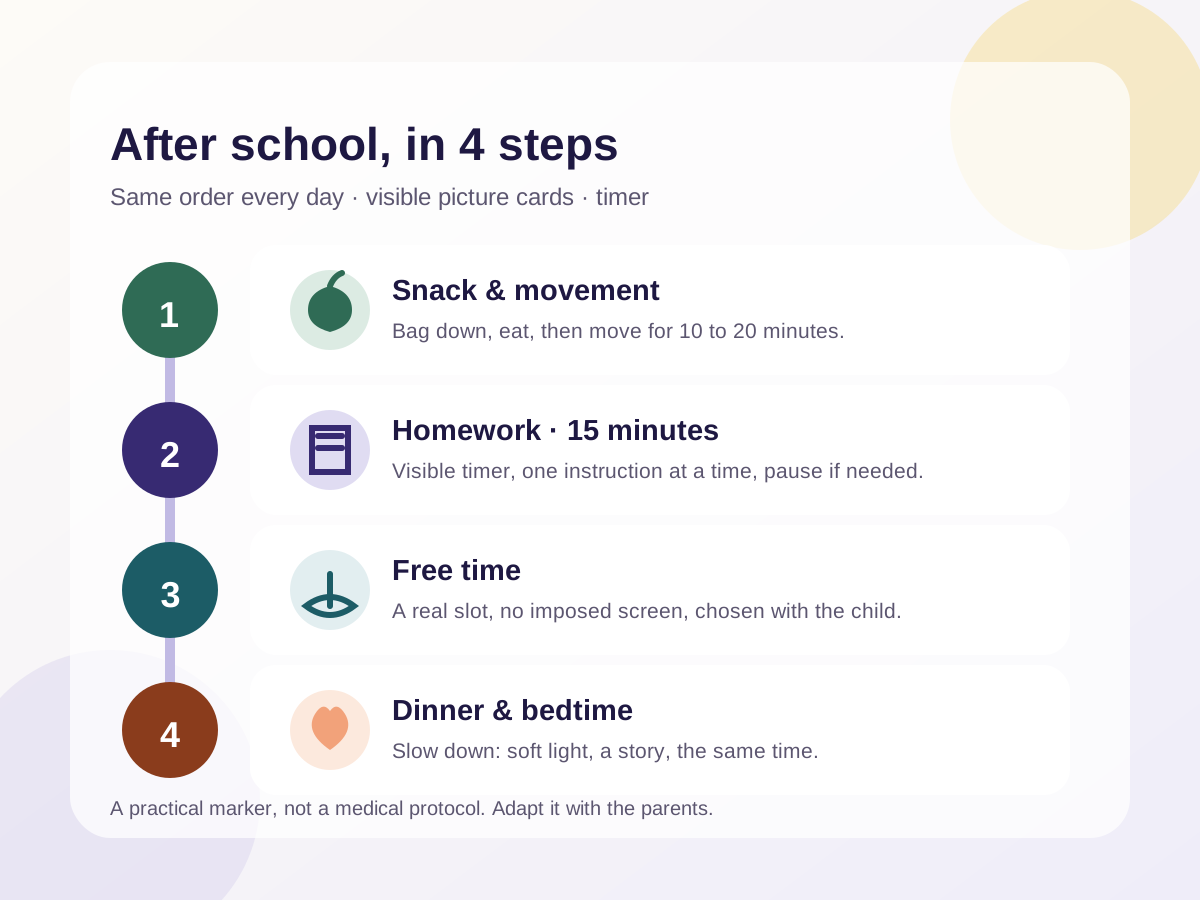
1. Snack and movement to decompress
Drop the school bag, eat, then move for ten to twenty minutes: trampoline, bike, dance, play outside. This physical outlet often helps bring down the tension built up at school before asking for cognitive effort.
2. Homework: fifteen minutes, no more
A visible timer, one instruction at a time, a short pause if attention drifts. Stop before saturation and note what blocked. The exact length is set with the parents and the teacher, not with an imposed figure.
3. Free time that is truly free
A slot with no instruction, where the child chooses an activity among two or three acceptable options. This recovery time is not a reward to be withdrawn: it is a need for regulation.
4. Dinner and bedtime
Slow down gradually: soft light, screens off, a story, the same bedtime. Evening regularity often matters more than the exact length of sleep.
The LIRE method for defusing tension
The LIRE method is a three-step communication tool drawn from Émilie Chatelain’s practice. It replaces neither a diagnosis nor medical follow-up: it simply helps the adult speak briefly, acknowledge the emotion and restore choice where the child has none left.
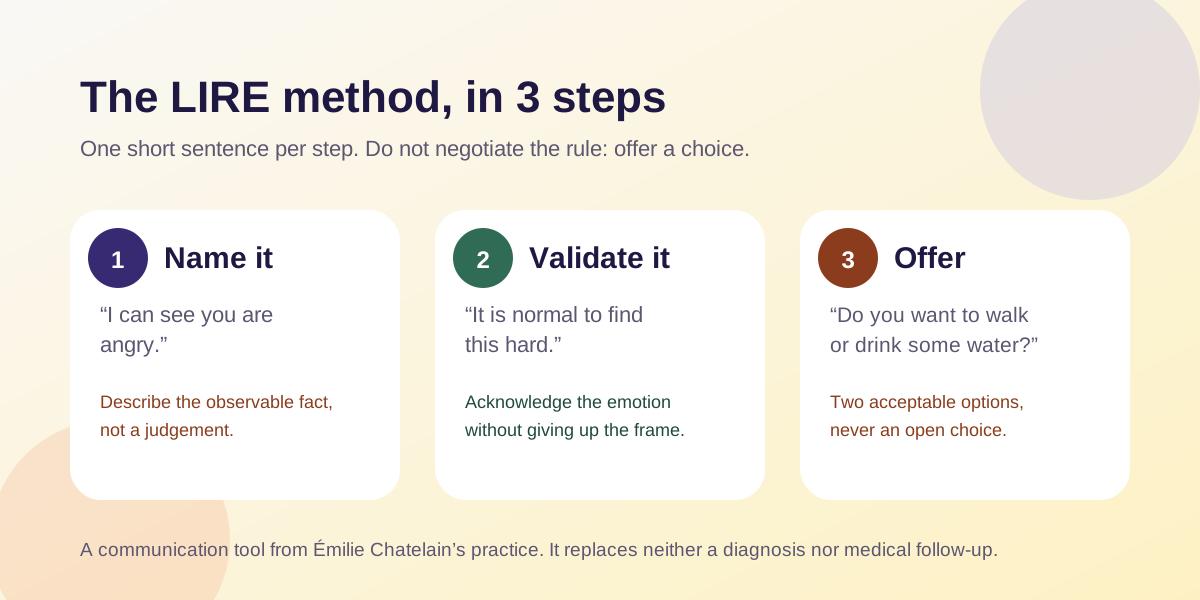
Step 1
Name it
“I can see you are angry.” Describe the observable fact, without judgement and without interpreting on the child’s behalf.
Step 2
Validate it
“It is normal to find this hard.” Acknowledge the emotion without giving way on the rule or the frame you have set.
Step 3
Offer a binary choice
“Do you want to walk or drink a glass of water?” Two acceptable options, never an open choice that restarts the negotiation.
Preventing and handling a meltdown without escalation
A meltdown is not manipulation. It is often the sign of an overload the child cannot yet name. The adult’s goal is not to win the confrontation, but to bring the intensity down safely.
Do
- — Reduce noise, light and the number of adults around.
- — Speak little and slowly, in short sentences.
- — Offer two concrete, acceptable choices.
- — Allow time to settle before talking again.
- — Call the parents if the situation goes beyond the frame.
- — In case of danger, call the local emergency number.
Avoid
- — Shouting louder to cover the child.
- — Physically restraining or locking the child in.
- — Humiliating, threatening or promising a disproportionate punishment.
- — Negotiating the rule in the middle of a meltdown.
- — Filming the meltdown without the parents’ consent.
- — Concluding alone that it is just a tantrum.
After the meltdown, do not reopen the topic straight away. Check that the child is safe, have a glass of water, then talk later in simple words. The facts are noted for the evening debrief.
The alliance with parents: the daily five-minute debrief
The quality of support depends less on techniques than on consistency between adults. A short, daily, factual debrief prevents misunderstandings and allows one thing at a time to be adjusted. It can be spoken or kept in a shared notebook.
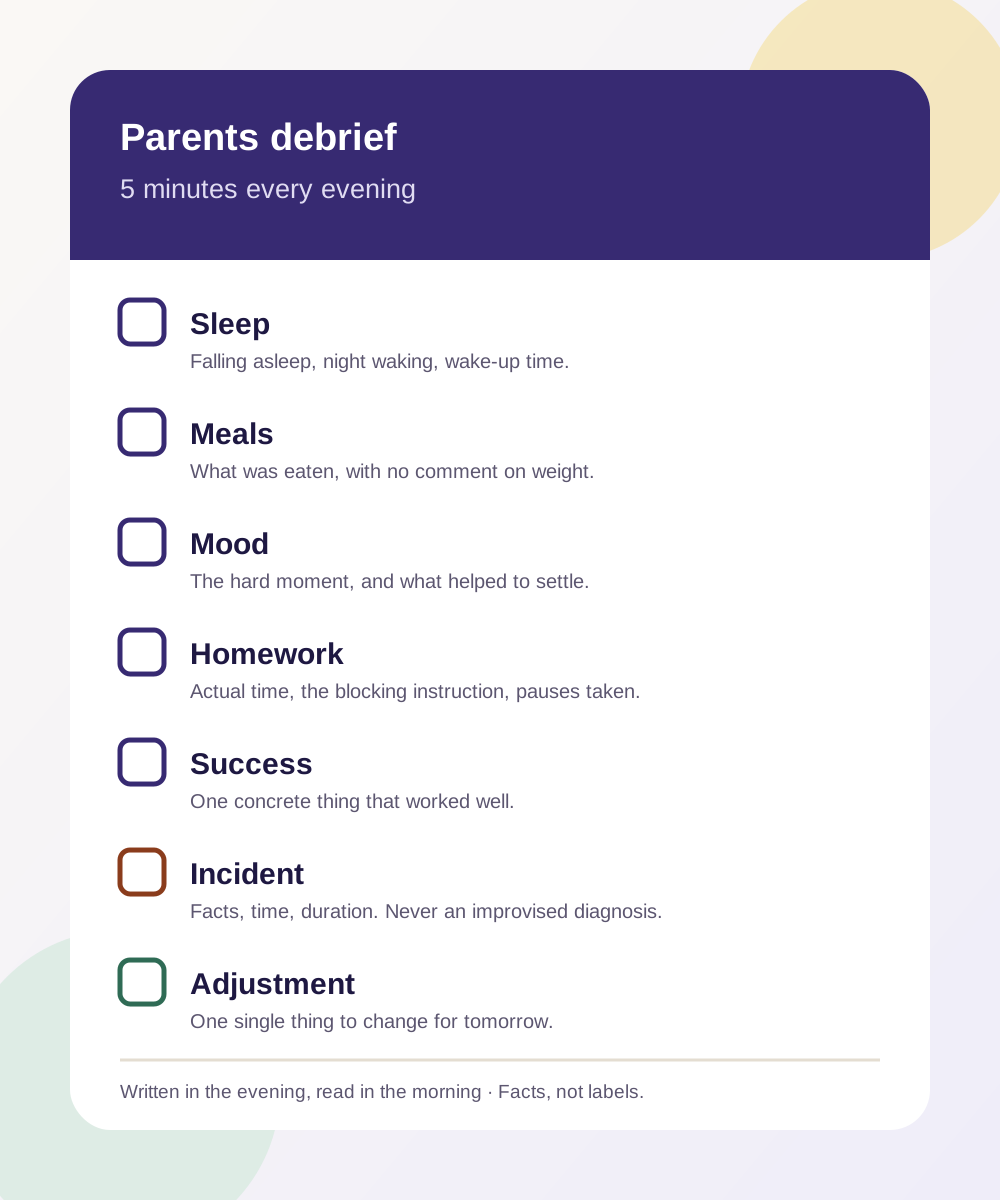
The seven points of the debrief
- Sleep: falling asleep, night waking, wake-up time.
- Meals: what was eaten, with no comment on weight.
- Mood: the hard moment and what helped to settle.
- Homework: actual time, the blocking instruction, pauses taken.
- Success: one concrete thing that worked well.
- Incident: facts, time, duration, with no improvised diagnosis.
- Adjustment: one single thing to change for tomorrow.
The notebook does not replace exchanges with health professionals. It gives parents concrete material for follow-up appointments, with no added interpretation.
What remains with parents and professionals
ADHD is not treated with a routine, and a routine never replaces follow-up. An au pair must know the limits of their role so as not to delay care or create conflict with the family.
- — Diagnosis and assessments belong to doctors and qualified psychologists.
- — Treatments, their dosage and their stopping belong to the prescribing doctor.
- — School accommodations are discussed between parents, the school and professionals.
- — Parenting decisions (screens, outings, punishments) remain with the parents.
- — In case of immediate danger, call the emergency services before informing the family.
If the au pair observes repeated deterioration, they raise it with the parents factually and with dates. They do not minimise, do not dramatise, and never promise to keep an incident secret.
About Émilie Chatelain’s expertise
This guide draws on the expertise of Émilie Chatelain, an ADHD specialist and host of the French podcast “Maman à maman, au cœur du TDAH”. Her work complements the routine and communication described here, without replacing medical follow-up.
The French version of this guide links to her resources. This English version names her expertise only and carries no external link.
Frequently asked questions
Can an au pair diagnose ADHD?
No. Diagnosis belongs to a doctor or a qualified psychologist. An au pair can observe facts, note what helps or blocks, and pass those observations to the parents, without labelling the child or changing any treatment.
What routine works after school?
Always the same order: snack and movement to decompress, a short homework slot with a visible timer, freely chosen free time, then dinner and bedtime. Picture cards at the child’s eye level make the sequence predictable.
What should I do during a meltdown?
Secure the space, speak little and calmly, offer two acceptable choices, then let the child come down before talking again. Do not shout, do not restrain the child and do not negotiate the rule mid-meltdown. If there is danger, call the parents and the emergency services.
How long should homework last?
A short fifteen-minute slot is a practical marker, not a medical rule. Break the task down, pause if needed, and stop before saturation. Parents adjust the length with the teacher and the professional following the child.
How do I talk about the day with the parents?
A five-minute debrief every evening: sleep, meals, mood, homework, one success, any incident and a single adjustment for tomorrow. Dated facts, no improvised diagnosis, in a notebook or a shared message.
Keep exploring
Prepare the stay with AuPair Connect
AuPair Connect brings together profiles, secure messaging and verification options to prepare the stay. The written agreement and health decisions remain between the family, the au pair and the relevant professionals.
Prepared by AuPair Connect — Compliance Team
Every legal, tax or safety detail in this content is verified by the AuPair Connect Compliance Team against official sources and dated.
Notice anything inaccurate or out of date? Help us keep this content up to date by writing to [email protected].